REST2: chignolin in explicit water, six states
Tested against md-tools 0.6.1. Every command and every number on this page comes from a
run executed as written, at that version.
A six-state REST2 ladder over chignolin, the designed ten-residue miniprotein (PDB 1UAO, sequence GYDPETGTWG), from the deposited NMR structure to 10 ns of production per state. Every command below was run exactly as written and every number is copied from the files that run produced, on NVIDIA RTX 3080 cards with CUDA and mixed precision.
The ladder took 22 min 55 s on one shared card, plus a few seconds to build and scale. On six cards it is about 7 min 30 s — the same physics either way; see step 5.
This is the peptide counterpart of REST2: paracetamol. The steps are the same; what differs is that a peptide needs no SDF — its unscaled torsions come from the residue table, not from bond orders — and that the ladder has to be spaced more tightly, which choosing τ_max measures rather than asserts.
What this runs
Six copies at 300 K, one per GPU, differing only in how strongly the solute interacts: τ = 0, 0.06, 0.12, 0.18, 0.24, 0.3. State 0 is the real peptide, and neighbours swap every 2 ps. Backbone amide ω, aromatic rings and impropers are never scaled — for chignolin that is Tyr2 and Trp9's rings and eight amides, with Pro4 the exception, since a proline-like amide has no N–H to protect. The method: REST2.
1. The dataset root and the structure
1UAO is a solution-NMR entry with 18 models. A build needs one:
curl -O https://files.rcsb.org/download/1UAO.pdb
awk '/^MODEL/{m++} m==1{print} /^ENDMDL/{if(m==1) exit}' 1UAO.pdb \
    | grep -E '^(ATOM|TER)' > chignolin.pdb
echo END >> chignolin.pdb
That leaves 138 atoms: the ten residues with their hydrogens, free termini, no ligands or crystallographic water.
Building it from the sequence instead
build-top also takes a .seq — one line of residue names that tleap's sequence builds:
md-openmm build-top -i chignolin.seq -os built.xml -op built.pdb \
    -log built.log --config build-top.config
Name the terminal residues. A bare GLY TYR ... TRP GLY builds an uncapped chain and the
force field then has no template for it:
ValueError: No template found for residue 9 (GLY).  The atoms and bonds in the residue match
GLY, but the set of externally bonded atoms is missing 1 C atom.  Is the chain missing a
terminal capping group?
NGLY/CGLY give the charged termini 1UAO has, so the molecule is the same 138 atoms.
ACE ... NME would cap it instead, which is a different molecule.
It is not a substitute for this page. tleap's geometry is EXTENDED, not folded, so the same 1.5 nm padding wraps a much larger box: 8173 atoms and 2673 waters in 86.1 nm³, against 2553 and 803 in 28.7 nm³ here. Starting extended is the right choice for a folding study and the wrong one for reproducing these numbers.
2. Build the system
build-top.config:
solute:
  kind: peptide
solvent:
  model: TIP3P
  padding_nm: 1.5
hydrogen_mass_repartitioning:
  enabled: true
md-openmm build-top -i chignolin.pdb -os built.xml -op built.pdb \
    -log built.log --config build-top.config
From built.log:
Input interpretation
--------------------
  interpreted as              peptide/protein PDB
  small-molecule FF           not used (peptide-only input)
  solvent treatment           explicit TIP3P, periodic

Counts
------
  atoms                       2553
  residues                    819
  solute atoms                138
  waters                      803
  ions                        {'NA': 4, 'CL': 2}
Four Na⁺ against two Cl⁻ because chignolin carries −2, from Asp3 and Glu5. The box is a rhombic dodecahedron of 28.7 nm³, and HMR lets every later stage run at 4 fs.
There is no built.sdf. A peptide does not need one: the next step reads the residue table.
3. Build the six scaled states
scaler.config, beside the built System:
It took 2 s and wrote build/REST2/:
build/REST2/
├── system_state0.xml … system_state5.xml
├── scaler.yaml            what these files are and how they were made (sha256 of each)
├── scaler.log             the same, for a person
└── protein-unscaled.png   what stays unscaled, drawn
From scaler.log:
  schedule                    linear, 6 state(s), tau 0.0 .. 0.3
  solute                      138 atom(s)
  unscaled torsions           amide omega 8 bond(s), aromatic ring 16 bond(s), double bond 0 bond(s), impropers 14 term(s)
                              138 torsion term(s) unscaled, 317 scaled
  proline-like amides         1 bond(s), scaled
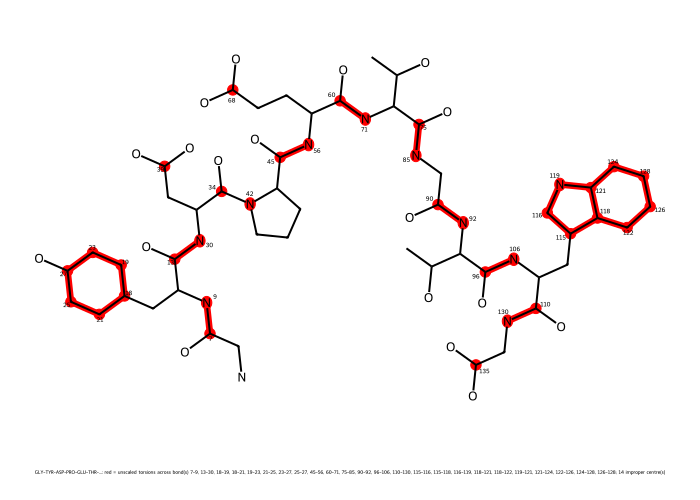
Red bonds keep every torsion across them unscaled in every state; red atoms are the centres of unscaled impropers. The eight backbone amides and both aromatic rings are protected. What REST2 heats are the 317 torsion terms left — the side chains, and the backbone φ/ψ that fold this peptide.
The picture does not depend on τ. Build the same system at tau_max: 0.5 and this file is
byte-identical: which torsions are unscaled is a property of the molecule and the rules, not of how
hot the ladder gets.
4. Generate the ladder
REST2.config at the dataset root:
protocol: REST2
solvent: explicit

rest2:
  number_of_replicas: 6          # must match build/REST2/scaler.yaml
  tau_max: 0.3                   # must match build/REST2/scaler.yaml
  exchange_interval_steps: 500   # 2 ps between exchange attempts at 4 fs
  number_of_exchanges: 5000      # 2,500,000 steps = 10 ns per state
  equilibration_steps: 25000     # 100 ps per state at its own Hamiltonian, before production

stages:
  minimization_iterations: 5000
  restrained_nvt_steps: 25000    # 100 ps
  restrained_npt_steps: 25000    # 100 ps
  unrestrained_npt_steps: 50000  # 200 ps

reporting:
  crd_printout_solute: 500       # a solute frame every 2 ps: 5000 frames per state
  crd_printout_whole: 25000      # every atom every 100 ps
  info_printout: 2500
  checkpoint_printout: 25000
number_of_replicas and tau_max scale nothing — they are a claim about build/REST2/, and
build-md refuses if they disagree with it. The group file it writes names the saved states, one
per line:
-i _protocol.py -p ../build/built.pdb -s ../build/REST2/system_state0.xml -c eq/eq_3.xml --group-index 0
…
-i _protocol.py -p ../build/built.pdb -s ../build/REST2/system_state5.xml -c eq/eq_3.xml --group-index 5
5. Run it
Six states need six workers. Give each one its own GPU if you have them:
run.sh minimises and equilibrates once on the unscaled system (min, eq_1, eq_2, eq_3 —
400 ps in total), then launches the ladder with one MPI rank per state. Each rank records the
device it got, and with six cards they are six different ones:
# platform           : CUDA device=0 (machine.openmm.device_policy: local_rank (rank 0 of 6)), precision mixed
…
# platform           : CUDA device=5 (machine.openmm.device_policy: local_rank (rank 5 of 6)), precision mixed
Six identical cards
The six states are one job: a slow card holds up every exchange it takes part in, and mixed
hardware makes the acceptance ratios below hard to read. CUDA_DEVICE_ORDER=PCI_BUS_ID makes
CUDA's numbering agree with nvidia-smi's, so CUDA_VISIBLE_DEVICES=1,2,3,4,5,6 means the
cards you think it does.
The numbers below came from one card, with all six workers sharing it under NVIDIA MPS — the
same arrangement REST2: paracetamol describes in full, including why a
private pipe directory matters and why the client then addresses the card as device 0. Sharing
costs wall time and nothing else: 628 ns/day per replica here, against about 1935 measured on six
separate cards in an earlier run of this ladder, with the acceptance ratios unchanged (0.133
overall in both).
It ended with run.sh: all stages reported completion.
6. Results
remd_records/REST2_prod1.out:
# steps completed       : 2500000 of 2500000
# exchanges             : 5000 (every 500 steps = 2.0 ps)
# whole frames          : 100 (every 25000 steps)
# solute frames         : 5000 (every 500 steps)
# production per replica: 10000.0 ps
# exchange rule         : neighbouring
# final state->walker   : [5, 4, 3, 2, 1, 0]
# NEIGHBOURING-PAIR acceptance:
#   basis: cumulative over every committed exchange row in the authoritative NetCDF, exchanges 0-4999
#   state 0 <-> state 1   382/2500   0.153
#   state 1 <-> state 2   350/2500   0.140
#   state 2 <-> state 3   338/2500   0.135
#   state 3 <-> state 4   308/2500   0.123
#   state 4 <-> state 5   287/2500   0.115
#   overall               1665/12500   0.133
# REST2:
#   tau ladder            0, 0.06, 0.12, 0.18, 0.24, 0.3   (6 state(s), one temperature 300.0 K, NVT)
#   solute region         138 atom(s), 24 unscaled central bond(s), impropers unscaled
#   velocities on swap    never rescaled (one beta across the ladder)
# TIMINGS:
#   elapsed               1374.9 s
#   throughput            628.42 ns/day per replica, 3770.52 ns/day aggregate over 6 state(s)
Acceptance is even across all five pairs — 0.115 to 0.153 — which is what a well-spaced linear
ladder looks like. final state->walker is [5, 4, 3, 2, 1, 0]: no walker ended where it started,
so configurations did travel.
Each state has its own trajectory, solute_state<i>_prod1.nc, 5000 frames of the 138 solute atoms.
The index is the state's, not the walker's: solute_state0_prod1.nc is the unscaled ensemble,
which is the one to analyse.
7. Checking state 0 against a plain run
State 0 integrates the unscaled Hamiltonian at 300 K, so it must agree with ordinary cMD on the same box. Against a length-matched 10 ns cMD run — not the 1 ns the cMD page documents, which would compare lengths rather than methods:
python compare_cmd_rest2.py --system chignolin \
    --cmd ../CHI-10ns/cMD-run1 --cmd-build ../CHI-10ns/build \
    --rest2 REST2-run1 --rest2-build build \
    --window 0.25 2.0 --out cmd-vs-rest2-rmsd.png
chignolin: backbone RMSD to the NMR model  [nm]
  cMD            n=5000  mean=0.13  sd=0.02  in-basin=0.00%  crossings= 0
  REST2 state 0  n=5000  mean=0.15  sd=0.06  in-basin=5.14%  crossings=80
  cMD            statistical inefficiency g=45.0  ->  112 independent sample(s) of 5000
  REST2 state 0  statistical inefficiency g=27.4  ->  183 independent sample(s) of 5000
  two-sample KS on the INDEPENDENT samples: D=0.2644  p=8.82e-05
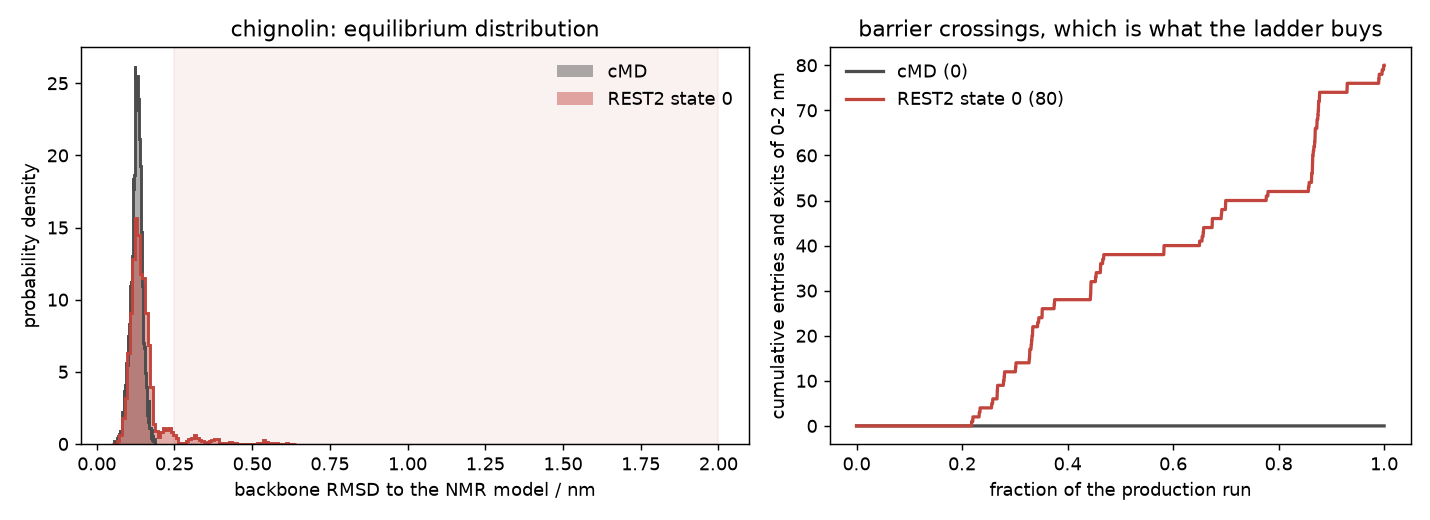
Both are 10 ns of the same Hamiltonian at the same temperature. They agree on the folded peak at 0.13 nm, and differ in the tail: the ladder's state 0 leaves the folded basin 80 times and spends 5.14% of its frames beyond 0.25 nm, while the plain run does not leave it once.
The right-hand panel is worth reading as a warning as well as a result. The ladder's crossings do not begin until about 20% of the way in, and they arrive in bursts. Had this run been three times shorter it would have reported zero too, and looked exactly as converged as the cMD run does.
Here the ladder's g is SMALLER, which is not a contradiction
On alanine dipeptide the ladder's
statistical inefficiency came out larger than cMD's (14.6 against 8.0); here it comes out
smaller (27.4 against 45.0). Both are consistent, because g describes whatever series it is
handed. A trapped run's correlation time is measured within its basin, and how that compares to
a run that moves between basins depends on the coordinate — on φ the basin is narrow and
fast, on backbone RMSD the folded state drifts slowly.
That is why g is not a sampling-quality score. The crossing count is: 0 against 80 means
one of these runs has not seen the transition, and no correlation analysis of its own frames
will reveal that.
Where this τ span comes from
τ_max is 0.3 because 0.5 was tried and gave 1% acceptance — a ladder that completes, reports and exchanges almost nothing while every file still looks right. The comparison: choosing τ_max.
See also
- the same ladder for a small molecule: REST2: paracetamol
- what the scaled states are: REST2
- a peptide built from a sequence, switched rather than exchanged: AIS: alanine dipeptide