cMD: chignolin in explicit water
Tested against md-tools 0.6.1. Every command and every number comes from a run executed as
written, at that version, on one RTX 3080.
1 ns of ordinary MD on the folded NMR structure of chignolin. Total time: 1 min 4 s.
Starts from a built system. Do the system page first: it takes the first NMR
model of 1UAO and writes CHI/build/built.xml, built.pdb and built.log.
1. Generate the run
cMD.config at the dataset root:
protocol: cMD
solvent: explicit

stages:
  minimization_iterations: 5000
  restrained_nvt_steps: 25000    # 100 ps
  restrained_npt_steps: 25000    # 100 ps
  unrestrained_npt_steps: 50000  # 200 ps
  production_steps: 250000       # 1 ns at 4 fs

reporting:
  crd_printout_solute: 500       # a solute frame every 2 ps
  info_printout: 2500
  checkpoint_printout: 25000
Lengths are integer step counts. timestep_fs stays auto and resolves to 4.0 fs, read from
the masses in built.xml rather than from this file — HMR has to be proved, not claimed. What
build-md writes and checks: build-md. Every key:
the configuration reference.
2. Run it
run.sh is five md-run calls in order — minimisation, three equilibration stages, production:
== min ==     min: 0 steps completed, 0 ps
== eq_1 ==    eq_nvt_posres: 25000 steps completed, 100 ps
== eq_2 ==    eq_npt_posres: 25000 steps completed, 100 ps
== eq_3 ==    eq_npt_free:   50000 steps completed, 200 ps
== cMD ==     cMD:          250000 steps completed, 1000 ps
3. What it wrote
CHI/
├── build/          built.xml, built.pdb, built.log
├── input/          min.in, eq_1.in, eq_2.in, eq_3.in, cMD.in
├── min/            min.xml, min.log, min.out, min.py
└── cMD-run1/
    ├── eq/                    eq_1.xml … eq_3.xml and their logs
    ├── solute_prod1.nc        solute trajectory, 500 frames (855 kB)
    ├── mdout.csv              the state table, 100 rows
    ├── energy_components.csv  the potential, term by term
    ├── cMD.xml                the final state
    ├── cMD.checkpoints/       the committed generations a resume continues from
    └── cMD.log                the machine-readable record
input/ and min/ are siblings of the run, not inside it: they belong to the system, and every
run on it shares them. Why, and what each file is: the run layout.
From cMD.out:
  timestep                     4.0 fs
  steps                        250000 (1000 ps)
  ensemble                     NPT
  platform                     CUDA
  Speed (ns/day)               mean 2328     rms fluctuation 249.339
  elapsed                      37.1 s
mdout.csv opens at step 102500, not at zero: the step counter is absolute across the chain.
4. What 1 ns sampled
Chignolin is here because it has a real folding equilibrium. Asking what the run saw of it, with
compare_cmd_rest2.py:
python compare_cmd_rest2.py --system chignolin \
    --cmd cMD-run1 --cmd-build build --window 0.25 2.0 --out cmd-rmsd.png
chignolin: backbone RMSD to the NMR model  [nm]
  cMD   n=500  mean=0.13  sd=0.01  in-basin=0.00%  crossings=0
        first/second half mean=0.13 / 0.13
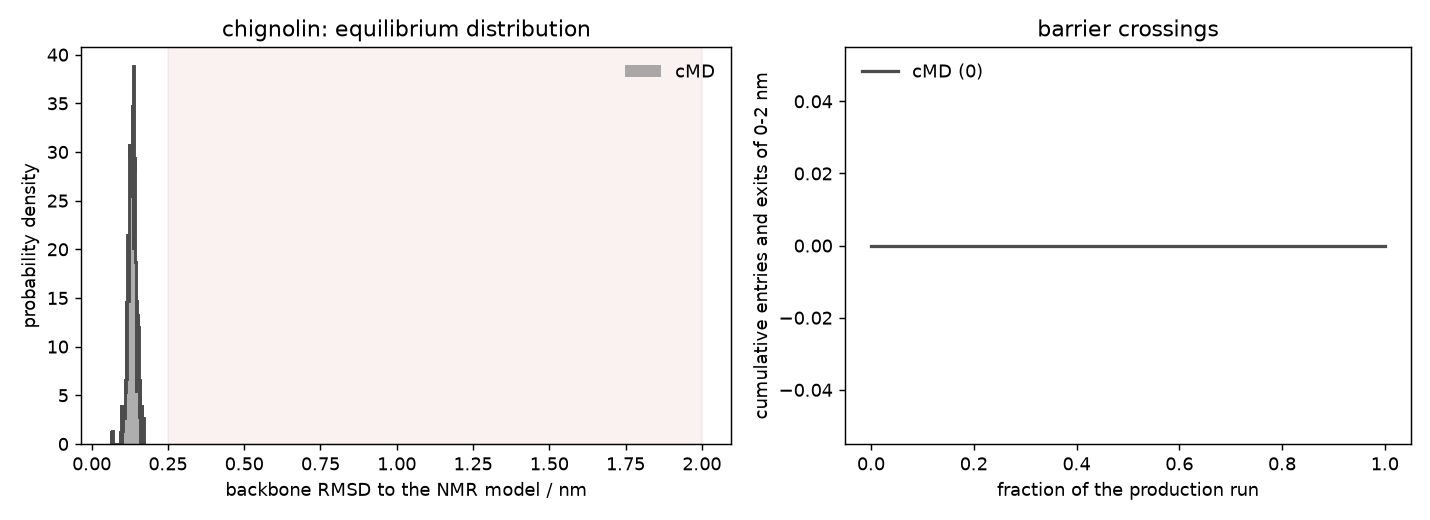
The peptide sits at 0.13 nm from the deposited structure and never leaves: 0.00% of frames above 0.25 nm, and not one excursion. The two halves agree to 0.00 nm.
That is the correct result for 1 ns and tells you nothing about folding. Chignolin's unfolding happens on the microsecond scale, so a nanosecond samples fluctuations within the folded state and nothing else — the narrow peak is a picture of one basin, not of an equilibrium between two. A run like this is a good check that the build is sound and a bad basis for any statement about stability.
Extending to 10 ns does not change it: still 0.00% and zero crossings. The ladder reaches 5.14% in 10 ns.
Next
1 ns is a demonstration. Chignolin folds on the microsecond scale, so raise production_steps —
or use the ladder:
- REST2: chignolin — the same peptide across six scaled states
- the system page — the other methods for chignolin