Ligand parameterization
Tested against md-tools 0.6.5 (development branch), CPU only for everything on this page except
the torsion fit, which ran on three GPUs and is described in section 3. Nothing here runs dynamics:
the page prepares small molecules and writes the REST2 states, and stops there. Every block of
output is from that run.
Two molecules, one question each:
| molecule | what it is | the question |
|---|---|---|
| Paracetamol | a 20-atom ligand with one acetamide | how is a ligand protonated, parameterised, and scaled — with Sage's torsions, and with torsions refitted to MACE-OMOL? |
| c(RGDfV) | a cyclic pentapeptide that is not a protein: solute.kind: peptide-like |
which torsions does REST2 protect, and which does it heat? |
Both are prepared the same way: the default pH (7.0), AM1-BCC charges, Sage 2.2.1. The three steps run in this order, and each is recorded in the build log:
- Protonation at a stated pH, by Open Babel.
- Parameters: Sage 2.2.1 torsions (or refitted ones) and AM1-BCC charges, once, into a reusable package.
- Which torsions REST2 will heat, decided when the scaled states are written.
1. Protonation comes first
protonation.ligand_method is openbabel by default, and protonation.ph is the pH it is applied
at: 7.0 unless you state another. That key is shared with the protein half of a build. Every
configuration on this page leaves it at the default, which is why the logs say pH 7.0.
Open Babel's pH model (OBMol.AddHydrogens(False, True, pH), the call behind obabel -p) runs on
the molecule before the charges are calculated, for a .smi, .sdf or .mol2:
echo "CC(=O)O acetic-acid" > acid.smi
md-openmm build-top --parameterize -i acid.smi --config acid.config \
    -op parameter/ACT.pdb -os parameter/ACT.xml -log parameterize.log --resname ACT
  coordinates   embedded from the SMILES CC(=O)[O-]; protonation: Open Babel 3.2.1 at pH 7.0:
                net charge +0 -> -1; CC(=O)O -> CC(=O)[O-]
  package       LOCAL-QTBSBXVTEAMEQO/param_c565813e02ae   (created)
The acid was parameterised as acetate. To parameterise a molecule exactly as written, state it:
  coordinates   embedded from the SMILES CC(=O)O; protonation: none -- the molecule is
                parameterised exactly as its input encodes it
  package       LOCAL-QTBSBXVTEAMEQO/param_ea2b994b0ea3   (created)
Same compound (LOCAL-QTBSBXVTEAMEQO), two different packages: a package is one exact chemical
state, so the neutral acid and the acetate never match each other in a search.
What this is not
It is a table of functional-group rules, not a pKa predictor. A carboxylic acid is ionised
and an aliphatic amine protonated at this pH; a phosphate and an imidazole are left as written.
It changes hydrogens and formal charges only, and a result that changes the heavy-atom graph or
the stereochemistry is refused. A molecule it leaves unchanged is used as the same object, so a
docked pose keeps its hydrogens. Open Babel missing is an error, never a fall back to none.
Both molecules below are left unchanged — paracetamol has nothing to ionise, and the RGDfV SMILES is already written as the zwitterion — and the log says so:
2. A ligand: paracetamol with Sage's torsions
para.config:
solute:
  kind: ligand
  compound_id: CHEMBL112
  aliases: [paracetamol, acetaminophen, TYL]
  parameters: generate
md-openmm build-top --parameterize -i paracetamol.smi --config para.config \
    -op parameter/TYL.pdb -os parameter/TYL.xml -log parameterize.log --resname TYL
  package   CHEMBL112/param_e932f4c4f371   (created)
  charges   am1bcc / am1bcc by ambertools-sqm
  force field   openff-2.2.1
The identity param_e932f4c4f371 is the one the paracetamol tutorials
use: the package is identified by its chemical state and its parameters, so the same molecule
reproduces the same package. Then the box, reusing that package (build.config):
md-openmm build-top -i ../parameter/TYL.sdf --config build.config -os built.xml -op built.pdb -log built.log
cp ../parameter/TYL.sdf .        # the bond orders the scaler reads, beside the System
  ligand pH    : Open Babel 3.2.1 at pH 7.0: no change
  parameters   : CHEMBL112/param_e932f4c4f371 (reused (stated reference))
  solvation    : 580 waters, ions {'NA': 2, 'CL': 2}, box dodecahedron (18.5 nm^3)
Which torsions REST2 heats, for a ligand
scaler.config:
  unscaled torsions   amide omega 0 bond(s), non rotatable 6 bond(s), impropers 24 term(s)
                      48 torsion term(s) unscaled, 26 scaled
  ligand amides       1 bond(s), scaled (the omega protection is for peptides; peptide-like
                      residues: none, from build record built.log (solute.kind: ligand))
A ligand's amide is scaled. Paracetamol's acetamide has a real alternative state behind a barrier, and a ligand has no backbone reference ensemble that never visits it — scaling it is what REST2 is for. The six aromatic ring bonds are protected, and so are the 24 improper terms:
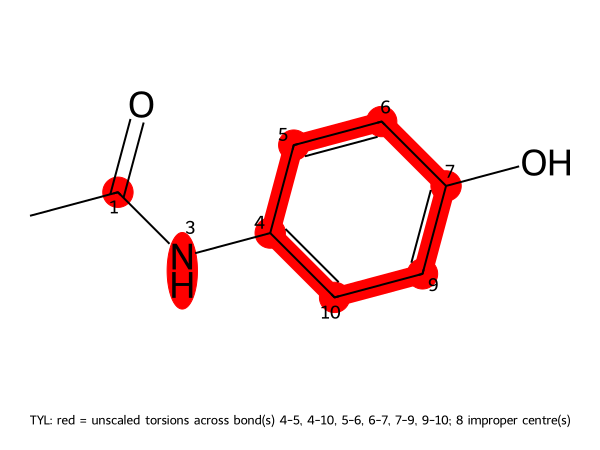
scaler_report.py (beside this page) sorts every bond a torsion can turn about:
amide omega          0
aromatic / double    6
    TYL:C3-C4 (4-5)   TYL:C3-C8 (4-10)   TYL:C4-C5 (5-6)
    TYL:C5-C6 (6-7)   TYL:C6-C7 (7-9)    TYL:C7-C8 (9-10)
scaled               4
    TYL:C1-C2 (0-1)   TYL:C2-N1 (1-3)    TYL:N1-C3 (3-4)    TYL:C6-O2 (7-8)
improper terms      24  (unscaled)
TYL:C2-N1 (1-3) is the acetamide C–N, scaled along with the methyl, the ring–nitrogen and the
hydroxyl rotations.
3. The same ligand with MACE-OMOL-refitted torsions
Sage's torsions are fitted to a broad set of molecules. For one molecule they can be refitted
against a reference of your choosing: BespokeFit scans each rotatable bond, relaxing the molecule at
every step, and fits new torsion terms to the energy profile. This page uses MACE-OMOL-0
(extra_large) as the reference, so torsion_refinement is mace-omol-bespokefit.
The fit is not run by build-top. It takes minutes to hours and uses GPUs, so it is never
implied by a build. Bespoke torsion fit shows how to install the tools and run it. You run BespokeFit in an environment you install and name yourself (BespokeFit,
QCEngine, mace-torch and the model weights are not part of this package's environment), and
build-top consumes the .offxml it writes. Asking for a refinement without that file is an error,
never a quiet fall back to Sage's torsions.
The fit used here, for the record:
| starting force field | Sage 2.2.1 (the unconstrained file BespokeFit fits against) |
| protonation | Open Babel at pH 7.4 in the fitting pipeline; paracetamol is unchanged at 7.0 and 7.4, so it is the same molecule |
| charges | the package's AM1-BCC charges, held fixed through every evaluation |
| reference | MACE-OMOL-0 extra_large, on three GPUs |
| scans | two 1-D torsion drives (24 points each, 15° grid), each point relaxed |
| result | converged in 4 ForceBalance iterations; 8.3 minutes in all |
| refitted bonds | the acetamide C–N and the N–aryl bond |
Validation against held-out MACE-OMOL scans (constrained optimisations half a grid step away, from a different conformer), relaxed-scan RMSE in kcal/mol:
| torsion | barrier | Sage 2.2.1 | refitted |
|---|---|---|---|
| acetamide C–N | 12.8 | 1.48 | 0.62 |
| N–aryl | 2.3 | 1.91 | 0.35 |
The fitted file is beside this page, data/ligand_sage_mace.offxml. Name it in the configuration
(para-bespoke.config):
solute:
  kind: ligand
  compound_id: CHEMBL112
  aliases: [paracetamol, acetaminophen, TYL]
  parameters: generate
  torsion_refinement: mace-omol-bespokefit
  refinement_offxml: data/ligand_sage_mace.offxml
md-openmm build-top --parameterize -i paracetamol.smi --config para-bespoke.config \
    -op parameter-bespoke/TYL.pdb -os parameter-bespoke/TYL.xml \
    -log parameterize-bespoke.log --resname TYL
  solute.torsion_refinement   mace-omol-bespokefit   (set)
  torsion refinement          mace-omol-bespokefit -- ligand_sage_mace.offxml (sha256 fb4121f2299f,
                              adds 6 proper torsion(s) to openff_unconstrained-2.2.1.offxml)
  package                     CHEMBL112/param_2f4449d70b95   (created)
  charges                     am1bcc / am1bcc by ambertools-sqm
The file is verified, not trusted: it must hold every proper torsion of Sage 2.2.1 unchanged, and add at least one. A stock file is refused ("it is the stock force field, and a package built from it would be a stock package under another name"), and so is a different base.
The package is a different package — param_2f4449d70b95 against param_e932f4c4f371 — because its
parameters are different. On the two refitted bonds, summed over every torsion across them (kJ/mol):
| bond | Sage 2.2.1 | MACE-OMOL refit |
|---|---|---|
| acetamide C–N | k₁ 5.36, k₂ 33.22 | k₁ 5.36, k₂ 33.22, k₃ 3.55 |
| N–aryl | k₂ 23.80 | k₂ 13.18, k₄ 1.25 |
The package records the method and the file's hash, and a search treats them as part of its identity: a refined package never matches a request for stock Sage, nor one refined another way.
Which torsions REST2 heats now
The same scaler command, on a box built from the refitted package (parameters: ../parameter-bespoke):
  unscaled torsions   amide omega 0 bond(s), non rotatable 6 bond(s), impropers 24 term(s)
                      48 torsion term(s) unscaled, 46 scaled
  ligand amides       1 bond(s), scaled (the omega protection is for peptides; peptide-like
                      residues: none, from build record built.log (solute.kind: ligand))
The classification is the same — one scaled amide, six protected ring bonds, 24 impropers — because which bonds are protected depends on the chemistry and not on the torsion parameters. What changed is how much there is to scale: 46 scaled torsion terms against 26, because the refit adds terms (periodicities 3 and 4) to the two bonds it refits.
4. A peptide-like molecule: c(RGDfV)
Cyclo(Arg–Gly–Asp–D-Phe–Val) is a peptide, but not a protein: it has no chain template, so it is
read from a .smi and parameterised by Sage like a ligand. kind: peptide-like says so. No torsion
refinement is applied to it.
CC(C)[C@@H]1NC(=O)[C@@H](Cc2ccccc2)NC(=O)[C@H](CC(=O)[O-])NC(=O)CNC(=O)[C@H](CCCNC(N)=[NH2+])NC1=O RGDfV
build-top.config:
md-openmm build-top -i RGDfV.smi -os built.xml -op built.pdb -log built.log --config build-top.config
  built 79 particles, 1 residues, implicit GBn2
  ligand packages     LOCAL-YYQUWEHEBOMRPH/param_7b0e047357d8 (written)
  ligand protonation  Open Babel 3.2.1 at pH 7.0: no change
The same scaler command on this System:
  unscaled torsions   amide omega 5 bond(s), non rotatable 9 bond(s), impropers 63 term(s)
                      139 torsion term(s) unscaled, 227 scaled
  guanidinium C-N     0 bond(s), scaled (a ligand's; protected in a protein or peptide-like residue)
  ligand amides       0 bond(s), scaled (the omega protection is for peptides; peptide-like
                      residues: ['RGD'], from build record built.log (solute.kind: peptide-like))
The five backbone amide ω bonds are protected, because the scaler read
solute.kind: peptide-like from the build record and treated the one non-protein residue as a
peptide. Their cis states are effectively a different chemical state, against a backbone that
never visits them; scaling them would buy distortion and no sampling.
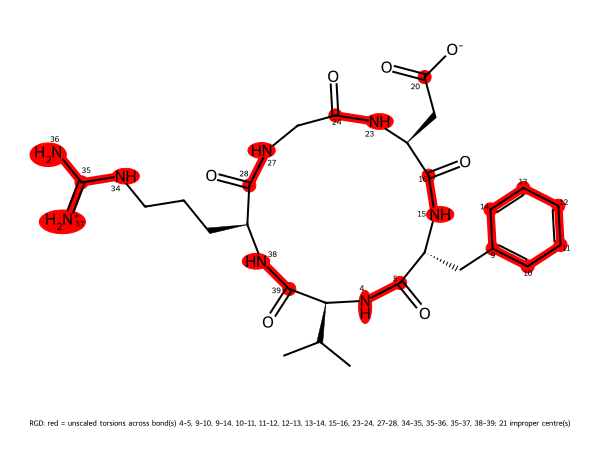
amide omega          5
    RGD:N1-C5 (4-5)    RGD:N2-C14 (15-16)   RGD:N3-C18 (23-24)
    RGD:N4-C20 (27-28) RGD:N8-C26 (38-39)
aromatic / double    9
    the six phenyl ring bonds (9-10 ... 13-14), and the three guanidinium C-N bonds
    RGD:N5-C25 (34-35)   RGD:C25-N6 (35-36)   RGD:C25-N7 (35-37)
scaled              21
    every φ, ψ and side-chain rotation: RGD:C1-C2, C2-C3, C2-C4, C4-N1, C4-C26, C5-C6,
    C6-C7, C6-N2, C7-C8, C14-C15, C15-C16, C15-N3, C16-C17, C18-C19, C19-N4, C20-C21,
    C21-C22, C21-N8, C22-C23, C23-C24, C24-N5
improper terms      63  (unscaled)
Everything that can rotate and is not an amide ω is scaled: the Cα–C and N–Cα bonds (φ, ψ), the valine, phenylalanine, aspartate and arginine side-chain rotations, 21 bonds in all. Only three kinds of bond stay at τ = 0:
- the amide ω bonds, as above;
- an aromatic ring bond or a double bond, which has no other conformer to reach: the phenyl ring, and the three guanidinium C–N bonds;
- every improper term.
The guanidinium is protected as a group
Delocalised, the three guanidinium C–N bonds are partly double, and which of them a SMILES
writes as the double bond is notation, not chemistry. In a peptide-like residue the scaler
protects all three, as it does for a protein's ARG; in a ligand it scales all three.
The classification never depends on how the SMILES was written. To change an individual
decision, list its central bond in unscaled_list or scaled_list in scaler.config.
The same molecule as a ligand
kind decides this, and nothing else does. Building the same SMILES with kind: ligand:
  unscaled torsions   amide omega 0 bond(s), non rotatable 6 bond(s), impropers 63 term(s)
                      87 torsion term(s) unscaled, 279 scaled
  guanidinium C-N     3 bond(s), scaled (a ligand's; protected in a protein or peptide-like residue)
  ligand amides       5 bond(s), scaled (the omega protection is for peptides; peptide-like
                      residues: none, from build record built.log (solute.kind: ligand))
The five backbone amides are now scaled, and so are the three guanidinium C–N bonds (279 scaled
terms against 227, 87 unscaled against 139).
If the molecule is a peptide, say so with peptide-like; if it is not, ligand is right. The
choice can also be stated per residue with peptide_like_residues in scaler.config, which wins
over the build record, an empty list included.
What to take from this
| ligand | peptide-like | |
|---|---|---|
| protonation | Open Babel, the stated pH | Open Babel, the stated pH |
| torsions | Sage 2.2.1, or refitted (torsion_refinement) |
Sage 2.2.1 |
| amide ω | scaled | protected |
| aromatic ring and double bonds | protected | protected |
| impropers | protected | protected |
| every other rotation | scaled | scaled |
Where the next pages go
The scaled states this page stops at are what a REST2 ladder integrates: see paracetamol REST2. Those runs were made under the earlier rule, which protected a ligand's amide, and carry a notice saying so.