REST2: paracetamol in explicit water, 10 ns per state
Tested against md-tools 0.6.1, except section 8.
Every command and every number up to section 7 comes from a run executed as written, at that
version.
Section 8 was run at 0.6.4, on the 0.6.1 run this page produced — and it could not have been
run at 0.6.1, which section 8 explains: before 0.6.4 an extension looked for a manifest name no
build-md tree has ever written, so no generated ladder was extendable. That is the realistic
case anyway: the parent is an older run and the extension is done with the version you have now.
The ligand amide is scaled in REST2 convention v4
The numbers below were measured under convention v3, which left a ligand's amide ω unscaled.
From v4 (2026-10-12) the ω protection belongs to peptides: an amide inside a non-protein residue
is scaled and listed under ligand_amide_scaled_bonds. A new build of this system therefore
protects one bond fewer, and its states are a different Hamiltonian with a different digest.
The page is kept as the record of the v3 run; re-run it to regenerate the numbers. See
REST2: the Hamiltonian.
A four-state REST2 ladder over paracetamol, 10 ns of production per state. Every command below was run exactly as written, and every number is copied from the files that run produced.
The molecule is not parameterised here: this page reuses the package cMD: paracetamol makes, so read that page first if you want to know where ligand parameters come from. The charge calculation happens once, there.
The ladder took 25.4 min on one shared GPU, plus a few seconds to build and scale.
What this runs
Four copies at 300 K, differing only in how strongly the solute interacts: state i scales solute–solute terms by (1−τ)² and solute–water by (1−τ), τ = 0, 0.167, 0.333, 0.5. State 0 is the real molecule, and neighbours swap configurations every 2 ps. Amide ω, aromatic rings, other double bonds and impropers are never scaled. The method: REST2.
1. The dataset root
A REST2 ladder gets its own dataset root, beside the cMD one rather than inside it: input/ is
shared by every run on a system, and this ladder's equilibration stages are longer than the cMD
page's, so build-md refuses to overwrite them. The parameters are shared; the box is not.
mkdir -p REST2-PARA/build
cd REST2-PARA/build
cp "$MD_DATA/parameters/ligands/CHEMBL112/param_e932f4c4f371/TYL.sdf" paracetamol.sdf
2. Build the system, from the registered package
build-top.config:
md-openmm build-top -i paracetamol.sdf \
    -os built.xml -op built.pdb -log built.log --config build-top.config
Resolved configuration
  solute.parameters           CHEMBL112/param_e932f4c4f371   (set)
  residue name                TYL   (stated)
Preparation
  parameters   : CHEMBL112/param_e932f4c4f371 (reused (stated reference))
  solvation    : 592 waters, ions {'NA': 2, 'CL': 2}, box dodecahedron (19.1 nm^3)
Counts
  atoms                       1800
  solute atoms                20
parameters names the package by identity, with no path: it is resolved in the shared catalog
under $MD_DATA/parameters/ligands, where md-openmm data-register --ligand-package put it. A
package that is not registered is named by its path instead — see
cMD: paracetamol.
reused (stated reference) means no charge was generated here. This box and the cMD page's box
rest on the same numbers, which is the point: a comparison between the two runs is a comparison of
sampling, not of parameters.
It also writes TYL.sdf beside the System. Keep it: it holds the bond orders, which is how the
next step knows which bonds are aromatic and which C–N is an amide.
3. Build the scaled states
scaler.config, beside the built System:
It took 1 s and wrote build/REST2/:
build/REST2/
├── system_state0.xml  system_state1.xml  system_state2.xml  system_state3.xml
├── scaler.yaml          what these files are and how they were made (sha256 of each)
├── scaler.log           the same, for a person
└── TYL-unscaled.png     what stays unscaled, drawn
From scaler.log:
  schedule                    linear, 4 state(s), tau 0.0 .. 0.5
  solute                      20 atom(s)
  unscaled torsions           amide omega 1 bond(s), aromatic ring 6 bond(s), double bond 0 bond(s), impropers 24 term(s)
                              56 torsion term(s) unscaled, 18 scaled
  SDF for TYL                 TYL.sdf
and TYL-unscaled.png — every red bond keeps all its torsions unscaled in every state, and every red
atom is the centre of an unscaled improper; the numbers are the atom indices scaler.yaml uses:
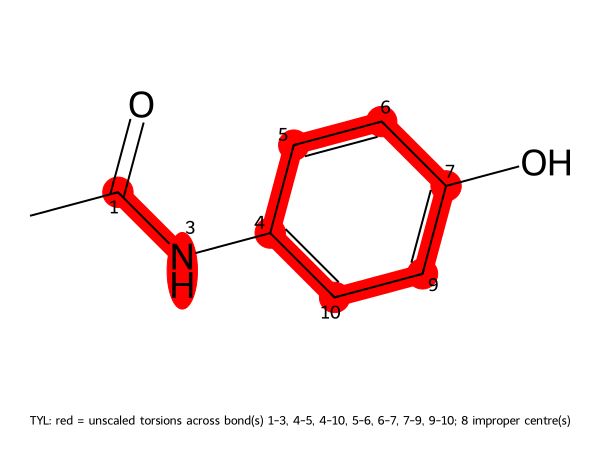
The amide (1–3) and the whole ring are protected — all six aromatic ring bonds, so the ring's own geometry is never heated and cannot distort.
What REST2 does heat are the 18 torsion terms left, and every one of them is about a bond OUTSIDE the ring:
| scaled bond | torsion | what moves |
|---|---|---|
| 3–4 | 1-3-4-5 | the acetamido group twists relative to the ring |
| 7–8 | 6-7-8-17 | the phenol O–H rotates |
| 0–1 | — | the acetyl methyl spins |
1-3-4-5 is an ordinary torsion, not a ring torsion. Its central bond 3–4 joins the ring carbon
to the amide nitrogen and is not part of the ring; it is exactly the kind of single bond between
two groups that REST2 exists to heat. The ring's own six bonds are a separate matter and stay at
tau = 0 in every state, which is what the red ring in the picture means and what scaler.yaml
records as six aromatic_ring entries.
4. Generate the ladder
REST2.config at the dataset root:
protocol: REST2
solvent: explicit

rest2:
  number_of_replicas: 4          # must match build/REST2/scaler.yaml
  tau_max: 0.5                   # must match build/REST2/scaler.yaml
  exchange_interval_steps: 1000  # 2 ps between exchange attempts
  number_of_exchanges: 5000      # 5,000,000 steps = 10 ns per state
  equilibration_steps: 50000     # 100 ps per state at its own Hamiltonian, before production

stages:
  minimization_iterations: 5000
  restrained_nvt_steps: 50000    # 100 ps
  restrained_npt_steps: 50000    # 100 ps
  unrestrained_npt_steps: 100000 # 200 ps

reporting:
  crd_printout_solute: 1000      # a solute frame every 2 ps: 5000 frames per state
  crd_printout_whole: 50000      # every atom every 100 ps
  info_printout: 5000
  checkpoint_printout: 50000
number_of_replicas and tau_max do not scale anything any more — they are a claim about
build/REST2/, and build-md refuses if they disagree with it.
The group file it writes names the saved states, one per line:
-i _protocol.py -p ../build/built.pdb -s ../build/REST2/system_state0.xml -c eq/eq_3.xml --group-index 0
-i _protocol.py -p ../build/built.pdb -s ../build/REST2/system_state1.xml -c eq/eq_3.xml --group-index 1
-i _protocol.py -p ../build/built.pdb -s ../build/REST2/system_state2.xml -c eq/eq_3.xml --group-index 2
-i _protocol.py -p ../build/built.pdb -s ../build/REST2/system_state3.xml -c eq/eq_3.xml --group-index 3
5. Run it
Four replicas need four workers. Give each one its own GPU if you have them:
This run had one card, so the four workers shared it — which md-tools allows only under NVIDIA MPS, and refuses otherwise:
md-run: REST2: this launch shares device 0 between 4 workers. NVIDIA MPS is not-a-client for this
process ... Without MPS, workers on one GPU are time-sliced: each waits for the others' kernels,
and a synchronous ladder runs at the pace of that shared GPU.
md-tools neither starts nor stops the daemon — that is the operator's decision, because an MPS daemon outlives the run. Start one that belongs to you, run, and stop it:
export CUDA_MPS_PIPE_DIRECTORY="$HOME/.cache/mps/pipe"    # keep this path SHORT: it holds a Unix
export CUDA_MPS_LOG_DIRECTORY="$HOME/.cache/mps/log"      # socket, and those cap at 108 characters
mkdir -p "$CUDA_MPS_PIPE_DIRECTORY" "$CUDA_MPS_LOG_DIRECTORY"
CUDA_VISIBLE_DEVICES=0 nvidia-cuda-mps-control -d

CUDA_DEVICE_ORDER=PCI_BUS_ID CUDA_VISIBLE_DEVICES=0 ./run.sh

echo quit | nvidia-cuda-mps-control
A private pipe directory matters: with the default one the daemon serves every card on the host, so a shared machine's other GPUs end up behind your daemon.
run.sh minimises and equilibrates once on the unscaled system (min, eq_1, eq_2, eq_3),
then launches the ladder, one MPI rank per state:
mpirun -n 4 md-openmm md-run -ng 4 -i ../input/REST2.in -p "${TOPOLOGY}" \
  --groupfile remd_groupfile.1 -odir . \
  -o remd_records/REST2_prod1.out -log remd_records/REST2_prod1.log -r remd_records/restart_prod1.json
Which GPU is which
CUDA numbers devices fastest first, nvidia-smi by PCI bus, so on a machine with mixed cards
CUDA_VISIBLE_DEVICES=1,2,3,4 need not be the GPUs nvidia-smi lists as 1–4. Put
CUDA_DEVICE_ORDER=PCI_BUS_ID in front to make the two numberings agree.
It finished in 19.5 min and ended with run.sh: all stages reported completion. Stages that had
already completed were skipped, not repeated — only the ladder ran.
6. Results
remd_records/REST2_prod1.out:
# steps completed       : 5000000 of 5000000
# exchanges             : 5000 (every 1000 steps = 2.0 ps)
# whole frames          : 100 (every 50000 steps)
# solute frames         : 5000 (every 1000 steps)
# production per replica: 10000.0 ps
# exchange rule         : neighbouring
# final state->walker   : [0, 3, 1, 2]
# NEIGHBOURING-PAIR acceptance:
#   basis: cumulative over every committed exchange row in the authoritative NetCDF, exchanges 0-4999
#   state 0 <-> state 1   544/2500   0.218
#   state 1 <-> state 2   553/2500   0.221
#   state 2 <-> state 3   565/2500   0.226
#   overall               1662/7500   0.222
# REST2:
#   tau ladder            0, 0.166667, 0.333333, 0.5   (4 state(s), one temperature 300.0 K, NVT)
#   scaling               solute-solute (1-tau)^2, solute-environment 1-tau
#   left unscaled         bonds unscaled, angles unscaled, torsions: ordinary amide omega, aromatic ring bonds, other double bonds, impropers
#   solute region         20 atom(s), 7 unscaled central bond(s), impropers unscaled
#   system sha256         52db01895dced19f084147c3fb2ce3168149fe6112b5d4859ce60b472dad5132
#   velocities on swap    never rescaled (one beta across the ladder)
# TIMINGS:
#   elapsed               1523.8 s
#   throughput            567.00 ns/day per replica, 2268.00 ns/day aggregate over 4 state(s)
#   per step              0.3048 ms
run_status: completed
An acceptance near 0.22 on every neighbouring pair is a usable ladder: high enough that configurations move, low enough that the states are telling each other something.
Both measurements below come from paracetamol_analysis.py, run from
the dataset root.
The walkers really travel. An acceptance ratio on its own does not show that: neighbours can swap busily while nothing ever crosses the ladder. Counting, per walker, full journeys from the physical state to the hottest and back:
The unscaled amide stays planar, and the scaled ring loosens. Measured on
solute_state<i>_prod1.nc, 5000 frames each, as circular standard deviations — 179° and −179° are
2° apart, not 358°, so an arithmetic spread is meaningless for an angle:
| torsion | fold | scaled? | state 0 (τ = 0) | state 1 | state 2 | state 3 (τ = 0.5) |
|---|---|---|---|---|---|---|
| amide ω, 0-1-3-4 | 1 | no | 12.2° | 12.3° | 12.0° | 11.7° |
| ring, 1-3-4-5 | 2 | yes | 26.4° | 37.9° | 60.1° | 54.6° |
The amide is unmoved from the physical state to the hottest, and there is not one cis frame in any state — 0 of 5000 with |ω| < 90°. That is the point of leaving it unscaled: a hot state that isomerised it would sample a geometry state 0 never visits, and every exchange would carry that geometry down the ladder. The ring, which REST2 is meant to free, widens from 26° to about 55–60° across the ladder.
The ring is 2-fold degenerate, and the raw angle hides that
Quoting the ring's spread without folding it gives 148.5°, 139.2°, 174.1°, 138.6° — no trend, and the hottest state apparently narrower than the physical one. Nothing is wrong with the run. The ring is para-substituted, so a 180° rotation maps the molecule onto itself and the raw distribution carries two copies of every feature; a spread computed over both copies measures the gap between them, which 10 ns does not pin down, rather than the width of the basin.
The fold is the number of equivalent positions, and it is a property of the molecular graph rather than of any conformation: the symmetry operations that fix the torsion's first three atoms carry the fourth onto {C4, C8}, the two ortho carbons, so the fold is 2. Folding the angle into −90°…+90° before taking the statistic gives the row above, and the expected trend appears. The same test returns 3 for a methyl rotation and 1 for the amide ω and the O–H, which have no degeneracy — so it needs no per-molecule judgement.
The files follow the thermodynamic state: solute_state0_prod1.nc is the physical ensemble, and
no demultiplexing is needed before analysing it. solute.yaml records that the ladder integrated
the saved states (detection_route: saved-state, and the sha256 of each).
One shared GPU is slower, and samples the same
This run put all four workers on one RTX 3080 under MPS and got 567 ns/day per replica. Earlier runs of the same ladder reached about 1400 ns/day per replica on four separate RTX 3080s and 738 on one shared A5000. The physics is identical across all of them — same Systems, same ladder, acceptance near 0.22, the same round-trip counts to within the scatter of a different random trajectory. A shared card costs wall time, not correctness.
7. Checking state 0 against a plain run
State 0 integrates the unscaled Hamiltonian, so it must agree with ordinary cMD of the same box. Against a length-matched 10 ns cMD run — not the 200 ps the cMD page documents, which would compare lengths rather than methods:
| folded ring spread | occupancy of −90…90° | crossings in 10 ns | |
|---|---|---|---|
| exact, by symmetry | — | 50.00% | — |
| 10 ns REST2, state 0 * | 25.5° | 48.5% | 282 |
| 10 ns cMD | 25.1° | 26.5% | 2 |
| 200 ps cMD (cMD page) | — | 0.00% | 0 |
* four replicas, so about 4× the aggregate sampling and GPU-seconds of the plain run.
On the coordinate that carries physics the two agree to half a degree — 25.5° against 25.1°, with the preferred orientation within 2°. The ladder has not found a different answer; it has found the same answer.
Where they differ is the occupancy, and that is a convergence diagnostic rather than a physical quantity. Because the two ring orientations are equivalent, a converged run must sit at exactly 50/50; the ladder reaches 48.5% and the length-matched plain run only 26.5%, having crossed the barrier twice in 10 ns against the ladder's 282.
Being far from 50/50 does not make an average wrong
It is tempting to read 26.5% against an exact 50% as the plain run being badly in error. It is not. The two orientations are indistinguishable, so no physical observable can tell them apart, and a run that failed to interconvert them still reports the correct distribution for everything that depends on the molecule's geometry — as the folded spreads show.
What the 50% test does measure is ergodicity over that rotation, and it costs nothing: no reference simulation, no error bar, just the molecule's point group. That makes it worth reporting even though it constrains no average. It matters when something else is coupled to the rotation — a neighbouring group, a binding pose — because then the two orientations stop being equivalent and the failure to interconvert becomes a real one.
8. Extending it: four more chunks of 10 ns
The run above is 10 ns per state. To take it to 50 ns, add four more 10 ns segments — not one 40 ns segment, for a reason given below.
Extension is out of place. --extend-from reads a COMPLETED run, leaves it byte-for-byte
unchanged, and writes a new directory holding only the new dynamics. A 50 ns chain is therefore
five immutable directories, not one that grew:
paracetamol/
  REST2-run1/          10 ns   the original
  REST2-run1-ext1/     10 ns   extends REST2-run1
  REST2-run1-ext2/     10 ns   extends REST2-run1-ext1
  REST2-run1-ext3/     10 ns   extends REST2-run1-ext2
  REST2-run1-ext4/     10 ns   extends REST2-run1-ext3
Each segment extends the previous completed one, not the original. --extend N is in
EXCHANGE ATTEMPTS, and this ladder attempts one every 1000 steps, so 10 ns is
— the same number_of_exchanges: 5000 the configuration already names.
Run it through the GENERATED REST2.py, not through md-openmm md-run. md-run's parser
stops at --resume and --overwrite: it defines neither --extend nor --extend-from, so the
command fails in argparse before anything starts. Extension is a property of the ladder runtime,
and the generated entry point is the surface that reaches it.
A segment is a directory that carries its own copy of the generated helpers, because the script
locates resolved.config from __file__:
mkdir -p REST2-run1-ext1/eq
for f in REST2.py resolved.config remd_groupfile.1 eq/eq_3.xml; do
  cp -p "REST2-run1/$f" "REST2-run1-ext1/$f"
done
cd REST2-run1-ext1

CUDA_DEVICE_ORDER=PCI_BUS_ID CUDA_VISIBLE_DEVICES=1,2,3,4 \
mpirun -n 4 python REST2.py -ng 4 -p ../build/built.pdb \
  --groupfile remd_groupfile.1 \
  --extend 5000 --extend-from ../REST2-run1 \
  --extend-manifest remd_records/restart_prod1.json
No -s. A ladder reads its saved states only from the group file, and the extension's copy
names the same build/REST2/system_state<i>.xml the parent integrated.
--extend-manifest, and why only the first chunk needs it
An extension finds its parent by reading that parent's completion manifest, and the two kinds of parent file it differently:
| the parent is | its manifest is at | flag needed |
|---|---|---|
the original run, from run.sh |
remd_records/restart_prod1.json |
yes |
| a previous extension segment | restart.json, at the segment root |
no |
So chunk 1 passes --extend-manifest remd_records/restart_prod1.json and chunks 2 to 4 pass
nothing: the default is already right. Passing the flag to chunk 2 refuses read-only, naming the
file it did not find — which is how to tell the two cases apart if you are unsure.
Before 0.6.4 the assumed name was the ONLY name, and since no build-md tree has ever written it,
no generated ladder was extendable at all. If you are extending a run made by 0.6.1, 0.6.2 or
0.6.3, run the extension with 0.6.4 or later: it continues the older parent (its Hamiltonian
identity is recognised across the version), but the older code cannot find the manifest.
The next chunk is the same command with ext1 → ext2, --extend-from ../REST2-run1-ext1, no
--extend-manifest, and the helpers copied from REST2-run1-ext1 rather than from REST2-run1.
The chain on this page was run. Four chunks, 50 ns in total, and each segment's restart.json
pins its parent by the sha256 of that parent's manifest, checkpoint, analysis file and all four
state trajectories — so the chain is checkable rather than a naming convention:
ext1  parent REST2-run1        at 5,000,000 steps / 10 ns   ->  10,000,000
ext2  parent REST2-run1-ext1   at 10,000,000 / 20 ns        ->  15,000,000
ext3  parent REST2-run1-ext2   at 15,000,000 / 30 ns        ->  20,000,000
ext4  parent REST2-run1-ext3   at 20,000,000 / 40 ns        ->  25,000,000
Overall exchange acceptance was 0.2216, 0.2255, 0.2257, 0.2256 across the four — stable, as one continuing experiment should be rather than four different ones.
No timing is quoted, deliberately. The four segments ran under different card placements on a shared machine, and per-step times across them differ by 2.5x for that reason alone. A rate measured that way describes the machine's load, not the software.
The group file is still the parent's, and still names the same build/REST2/system_state<i>.xml
saved states. An extension integrates the same Hamiltonians as the run it continues; a ladder that
changed states mid-chain would not be one experiment.
Why four chunks and not one
An extension segment is atomic: an interrupted one is REDONE, not resumed
There is no mid-extension restart. --resume with --extend-from is refused as two different
operations. Worse, --resume alone on a partial segment's directory is not refused — it
would continue the run and write a restart.json with no extends block, so the segment would
finish looking like an ordinary run, with its parent pinning and chain accounting silently
gone.
So an interruption costs you the whole segment. Four 10 ns chunks lose at most 10 ns; one 40 ns segment loses 40. That is the entire reason to chunk.
Re-running into a partial directory is refused three ways (--force is refused with
--extend-from, --overwrite does not apply, and the existing -x/-r/checkpoint collide).
The answer is a fresh directory and the whole segment again.
What the chain records
Each segment's restart.json carries an extends block pinning its parent by content, plus the
parent's final exchange index as its own starting point. That is what makes the chain checkable
rather than a naming convention: a segment cannot be re-parented by renaming a directory, and a
gap or an overlap between two segments is visible in the records rather than inferred from
filenames.
For analysis, treat the five segments as one trajectory in order. Each carries its own
solute_state<i>_prod1.nc per state, and the state index means the same thing in all of them —
state 0 is the physical ensemble in every segment, as it is in the original run.
Next
- where the parameters came from: cMD: paracetamol
- the same parameters in a protein pocket: the TYK2 complex
- a ladder over a peptide: REST2: chignolin
- the method page's full account of extension, including what each record holds: REST2 — storage, restart and validation
- register the finished directory as a dataset: Registering a finished run