AIS: paracetamol in explicit water
Tested against md-tools 0.6.1. Every command and every number on this page comes from a
run executed as written, at that version.
The ligand amide is scaled in REST2 convention v4
The numbers below were measured under convention v3, which left a ligand's amide ω unscaled.
From v4 (2026-10-12) the ω protection belongs to peptides: an amide inside a non-protein residue
is scaled and listed under ligand_amide_scaled_bonds. A new build of this system therefore
protects one bond fewer, and its states are a different Hamiltonian with a different digest.
The page is kept as the record of the v3 run; re-run it to regenerate the numbers. See
REST2: the Hamiltonian.
The AIS chain of AIS: alanine dipeptide, applied to a small molecule given as SMILES.
Read that page first: it explains each step, and this page shows only where the ligand route differs
and what the run produced. Every command below was run exactly as written, and every number is
copied from the files that run produced. The run used md-tools at commit 3da35d0 on one NVIDIA RTX
3080, with CUDA and mixed precision.
It took about 10 minutes. Building took 3.1 s — the charges are not calculated here, they are read from the package — scaling took 1 s, and the chain from minimisation to the last switching path took 9 min 42 s.
1. The system, with a residue name
build/paracetamol.smi:
build/build-top.config:
solute:
  kind: ligand
  residue_name: TYL
  parameters: CHEMBL112/param_e932f4c4f371
solvent:
  model: TIP3P
  padding_nm: 1.5
hydrogen_mass_repartitioning:
  enabled: true
md-openmm build-top -i build/paracetamol.smi \
    -os build/built.xml -op build/built.pdb -log build/built.log --config build/build-top.config
solute.parameters names the package this molecule's parameters come from, so no charges are
generated here: they are read from the package that cMD: paracetamol
made and data-register --ligand-package put in the shared catalog. Give a path to a package
directory instead if it is not registered. The switching paths and the cMD box therefore rest on
identical ligand parameters — an AIS result and an ordinary MD result for this molecule differ in
sampling, not in the Hamiltonian's ligand terms.
solute.residue_name names the molecule's residue in built.pdb, and the bond-order file is named
after it, TYL.sdf, so the scaler finds the SDF by the residue it describes. Without a name the
residue is UNL and the file built.sdf. From build/built.log:
Input interpretation
--------------------
  interpreted as              single-molecule SMILES
  smiles                      CC(=O)Nc1ccc(O)cc1
  residue name                TYL   (stated)
  small-molecule FF           sage-2.2.1

Validation
----------
  particle agreement          1800 atoms == 1800 particles  OK
  solute residue              TYL  OK
  HMR                         applied, target 3.024 amu, recommend 4.0 fs

Counts
------
  atoms                       1800
  residues                    597
  solute atoms                20
  waters                      592
  ions                        {'NA': 2, 'CL': 2}
  forcefield                  openff-2.2.1

Outputs
-------
  built.xml                   build/built.xml
  built.pdb                   build/built.pdb
  built.solute.pdb            build/built.solute.pdb
  TYL.sdf                     build/TYL.sdf
Keep TYL.sdf. It holds the bond orders, which is how the next step knows which bonds are
aromatic and which C–N is an amide.
2. Build the two end states
build/scaler.config is the same file as for alanine dipeptide:
It writes both end states, and the index ascends with τ exactly as in a REST2 ladder:
system_state0.xml is τ 0 — V1, the physical molecule — and system_state1.xml is τ 0.5 — V0,
what the source ensemble samples. V0/V1 number the λ endpoints, not the τ values, so the
digits invert; the alanine page has the table.
md-openmm build-top --rest2-scaler -s build/built.xml -p build/built.pdb --config build/scaler.config
From build/AIS/scaler.log:
  solute                      20 atom(s)
  unscaled torsions           amide omega 1 bond(s), aromatic ring 6 bond(s), double bond 0 bond(s), impropers 24 term(s)
                              56 torsion term(s) unscaled, 18 scaled
  SDF for TYL                 TYL.sdf
  picture of TYL              TYL-unscaled.png  (TYL: red = unscaled torsions across bond(s) 1-3, 4-5, 4-10, 5-6, 6-7, 7-9, 9-10; 8 improper centre(s))
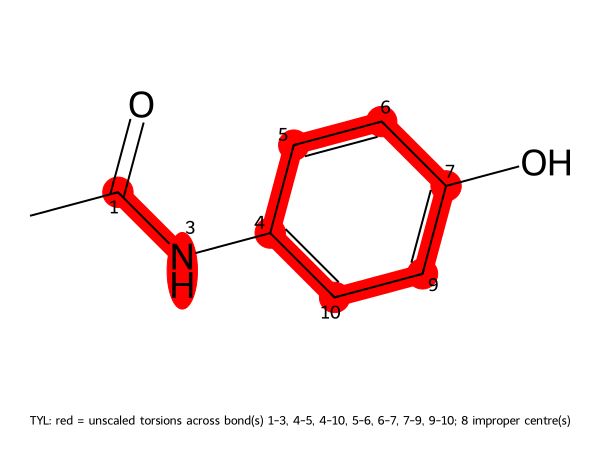
The amide (1–3) and the whole ring keep their full strength in V0. The hot state heats the other 18 torsion terms: the methyl rotation, the rotation of the ring about the N–C bond, and the O–H rotation.
3. Configuration and run
AIS.config is identical to the alanine dipeptide's, apart from a comment (see
step 3 there). build-md never names the
molecule. It reads the solute from build/.
md-openmm build-md -odir ./AIS-run1 --config AIS.config
cd AIS-run1
CUDA_DEVICE_ORDER=PCI_BUS_ID CUDA_VISIBLE_DEVICES=1 ./run.sh
| stage | what | wall time |
|---|---|---|
min |
1000 iterations, unscaled System | 0.9 s |
eq_1, eq_2, eq_3 |
100 ps each on V0 | 7.7, 7.6, 7.9 s |
source |
2 ns on V0, 1278 ns/day | 136.0 s |
AIS |
64 paths × 20 ps | 422.1 s |
The generated torsion list has 40 entries, named TYL1_<atom>_<atom>_<atom>_<atom>. From AIS.log:
  mixed forces                NonbondedForce, PeriodicTorsionForce
  shared forces               3 identical in both, added once
  ...
  source ensemble             V0, CONFIRMED: whole_prod1.nc records the System digest 7cf85d3024395307..., which is -s
and from AIS.out:
    path   frame   obs  frames      W kJ/mol     reduced
  ----- ------- ----- ------- ------------- -----------
       0       5    21      21     -228.4085    -91.5708
       1       6    21      21     -226.5508    -90.8260
       2       7    21      21     -225.3365    -90.3392
As for alanine dipeptide, evenly_spaced used source frames 5 to 68 (see
the note there).
4. Reweight the torsions
With the same ais_reweight.py, for three torsions: the amide
TYL1_C1_C2_N1_C3 (unscaled), the ring about N–C TYL1_C2_N1_C3_C4 (scaled), and the O–H rotation
TYL1_C5_C6_O2_H7 (scaled):
paths                    64
work  mean / min / max   -226.57 / -229.82 / -221.03 kJ/mol
dF (Jarzynski, V0 -> V1) -227.24 kJ/mol  (-91.10 kT)
Kish effective samples   42.4 of 64
The work values span 8.8 kJ/mol, about 3.5 kT, narrower than for alanine dipeptide, so more of the paths count: 42 effective samples.
The amide, unscaled, looks the same in every curve. This is the expected result. V0 and V1 share this torsion's potential, so switching has nothing to change:
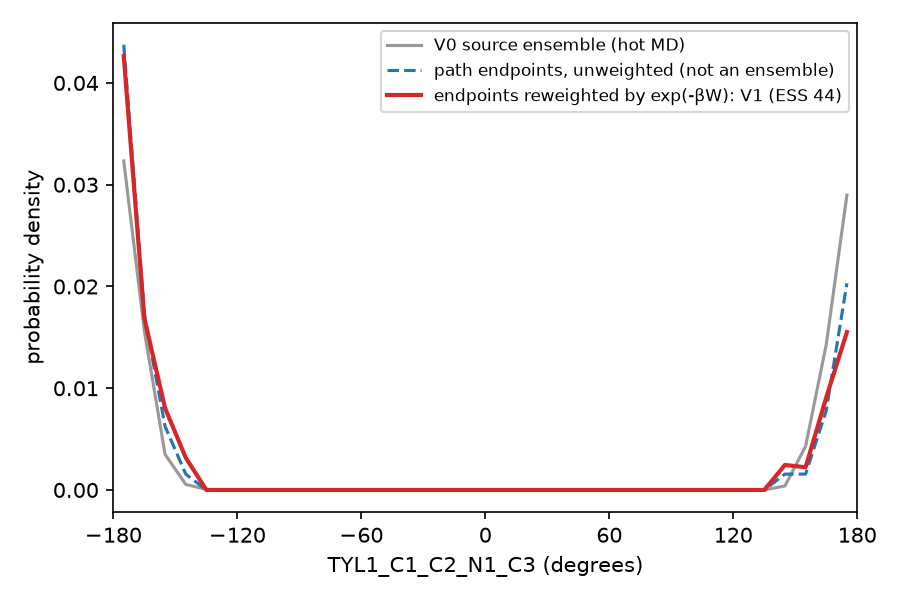
TYL1_C1_C2_N1_C3 is within 90° of trans in all 2001 source rows and in all 64 endpoints.
The ring rotation, scaled, shows the limit of 64 paths.
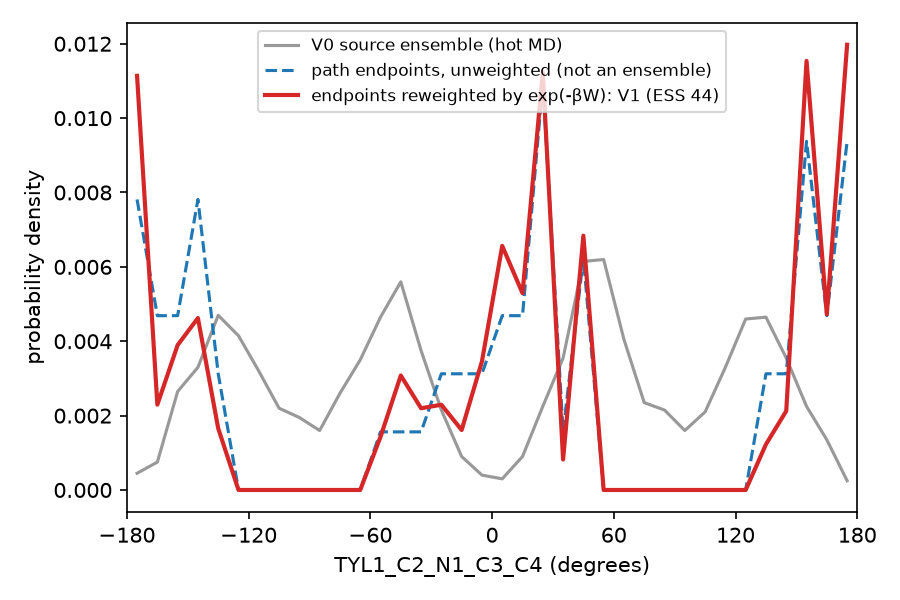
The grey source ensemble on V0 is smooth: 2001 rows over 2 ns, with four symmetric populations,
because the ring's two faces are equivalent. The red estimate of V1 rests on 42 effective endpoints
spread over 36 bins, and most of its spikes are single paths. It cannot show whether V1's
distribution differs from V0's for this torsion. For that, run more paths (NPROC=4 ./run.sh splits
them over four GPUs), or histogram with fewer bins (--bins 12).
dF = −227.3 kJ/mol is F(V1) − F(V0), as for alanine dipeptide: a check of the method, not a property of paracetamol.
Next
- where these parameters come from: cMD: paracetamol
- the peptide route, with every step explained: AIS: alanine dipeptide
- REST2 on the same molecule: REST2: paracetamol
- the method, the work convention and every file: AIS