REST2: alanine dipeptide, four states
Tested against md-tools 0.6.1. Every command and every number on this page comes from a
run executed as written, at that version, on four NVIDIA RTX 3080 cards.
A four-state REST2 ladder over the smallest system in this set: 22 solute atoms, τ = 0, 0.167, 0.333, 0.5, 10 ns of production per state. The ladder took 6 min 14 s.
Starts from a built system. Do the system page first.
This is the ladder to read first if you want to see what REST2 does without anything else going on. Alanine dipeptide has exactly two interesting torsions, φ and ψ, and cMD already crosses their barriers — so unlike chignolin or a protein–ligand complex, you can check the ladder's answer against a plain run rather than having to trust it.
What this runs
Four copies at 300 K, differing only in how strongly the solute interacts: state i scales solute–solute terms by (1−τ)² and solute–water by (1−τ). State 0 is the real dipeptide, and neighbours swap configurations every 2 ps. Both amide ω torsions and the impropers are never scaled. The method: REST2.
1. Build the four scaled states
build/scaler.config:
md-openmm build-top --rest2-scaler -s build/built.xml -p build/built.pdb --config build/scaler.config
From scaler.log:
  schedule                    linear, 4 state(s), tau 0.0 .. 0.5
  solute                      22 atom(s)
  unscaled torsions           amide omega 2 bond(s), aromatic ring 0 bond(s), double bond 0 bond(s), impropers 2 term(s)
                              14 torsion term(s) unscaled, 28 scaled
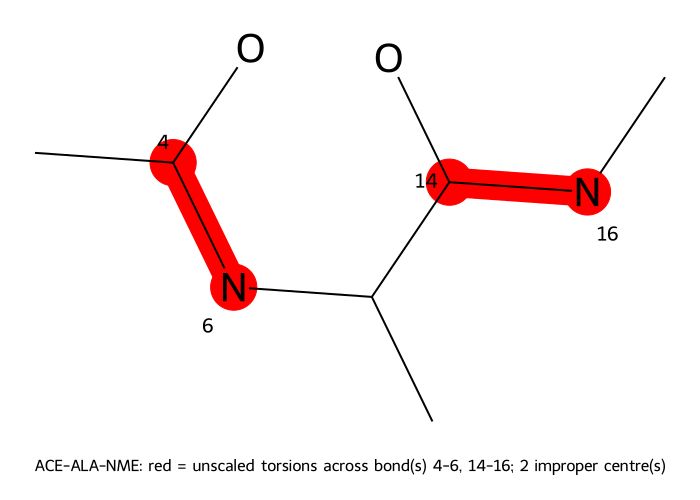
  picture of protein          protein-unscaled.png  (ACE-ALA-NME: red = unscaled torsions across bond(s) 4-6, 14-16; 2 improper centre(s))
Both amide C–N bonds — ACE–ALA (4–6) and ALA–NME (14–16) — keep every torsion across them at full strength in every state. What REST2 heats are the other 28 terms, including φ and ψ, which are the coordinates this system is about.
2. Generate the ladder
REST2.config at the dataset root:
protocol: REST2
solvent: explicit

rest2:
  number_of_replicas: 4          # must match build/REST2/scaler.yaml
  tau_max: 0.5                   # must match build/REST2/scaler.yaml
  exchange_interval_steps: 500   # 2 ps between exchange attempts at 4 fs
  number_of_exchanges: 5000      # 2,500,000 steps = 10 ns per state
  equilibration_steps: 25000     # 100 ps per state at its own Hamiltonian

stages:
  minimization_iterations: 5000
  restrained_nvt_steps: 25000    # 100 ps
  restrained_npt_steps: 25000    # 100 ps
  unrestrained_npt_steps: 50000  # 200 ps

reporting:
  crd_printout_solute: 500       # a solute frame every 2 ps: 5000 frames per state
  crd_printout_whole: 25000
  info_printout: 2500
  checkpoint_printout: 25000
number_of_replicas and tau_max scale nothing — they are a claim about build/REST2/, and
build-md refuses if they disagree with it.
3. Run it
Four replicas need four workers. Give each one its own GPU if you have them:
With fewer cards the workers share, which md-tools allows only under NVIDIA MPS and refuses
otherwise — the paracetamol ladder describes that arrangement
in full, including why the pipe directory must be short and why the client then addresses the card
as device 0.
4. Results
remd_records/REST2_prod1.out:
# steps completed       : 2500000 of 2500000
# exchanges             : 5000 (every 500 steps = 2.0 ps)
# solute frames         : 5000 (every 500 steps)
# production per replica: 10000.0 ps
# final state->walker   : [2, 3, 0, 1]
# NEIGHBOURING-PAIR acceptance:
#   state 0 <-> state 1   656/2500   0.262
#   state 1 <-> state 2   638/2500   0.255
#   state 2 <-> state 3   616/2500   0.246
#   overall               1910/7500   0.255
# REST2:
#   tau ladder            0, 0.166667, 0.333333, 0.5   (4 state(s), one temperature 300.0 K, NVT)
#   solute region         22 atom(s), 2 unscaled central bond(s), impropers unscaled
#   velocities on swap    never rescaled (one beta across the ladder)
# TIMINGS:
#   elapsed               374.4 s
Acceptance near 0.25 on every pair and almost flat across the ladder — 0.262, 0.255, 0.246 — which is what a well-spaced linear ladder looks like on a small solute. Compare paracetamol at 0.222 over the same τ span with 20 solute atoms, and chignolin, which needs six states to reach only τ = 0.3 with 138 atoms: the number of rungs a τ span needs grows with the size of the heated region, and this is the smallest region in the set.
final state->walker is [2, 3, 0, 1]: no walker ended where it started.
Each state has its own trajectory, solute_state<i>_prod1.nc, 5000 frames of the 22 solute atoms.
The index is the state's, not the walker's: solute_state0_prod1.nc is the unscaled ensemble,
and it is the one to analyse. No demultiplexing is needed.
5. Checking the answer against a microsecond
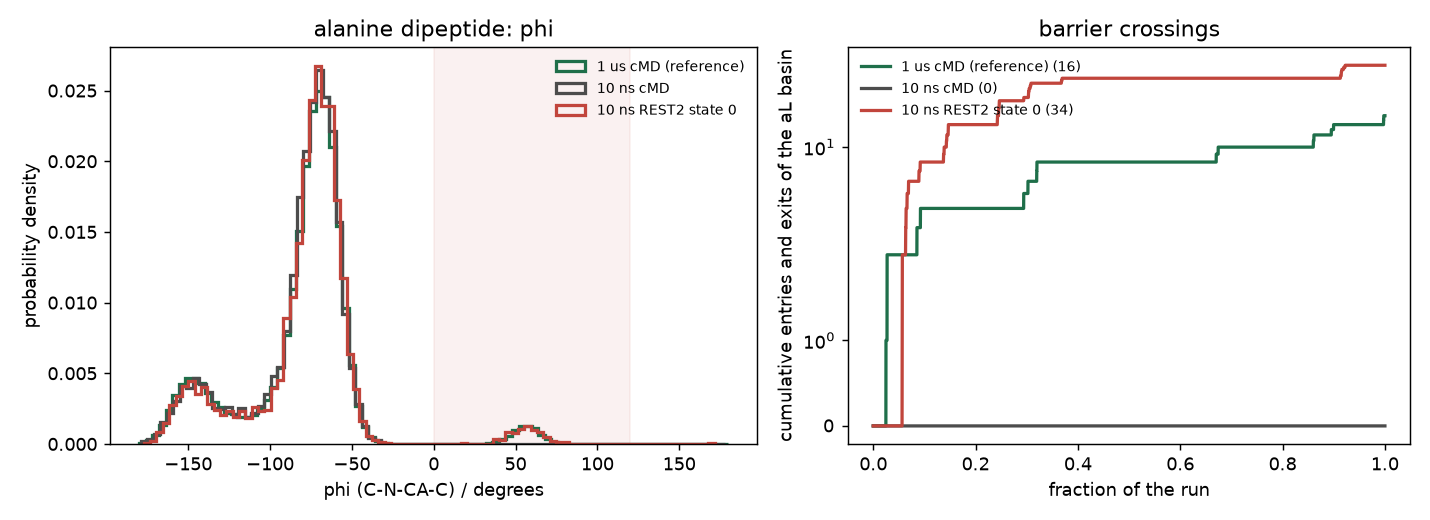
State 0 integrates the unscaled Hamiltonian at 300 K, so it must agree with ordinary MD of the same box. The thing to check it against is not the 10 ns run on the cMD page — that one never reaches the αL basin at all — but a 1 µs reference, 100 times longer.
| run | cost | time in the αL basin | entries | per ns |
|---|---|---|---|---|
| 1 µs cMD — the reference | 8 h 32 m | 2.76% | 16 | 0.02 |
| 10 ns cMD | 5 min 14 s | 0.00% | 0 | 0.00 |
| 10 ns REST2, state 0 * | 6 min 14 s | 2.80% | 34 | 3.40 |
| * The ladder is not free. Its four replicas each ran 10 ns, so it spent **40 ns of | ||||
| aggregate sampling and about 4.8× the GPU-seconds** of the plain 10 ns run (4 × 374 s | ||||
| against 314 s). Only state 0's 10 ns is usable output; the other three states exist to | ||||
| ferry configurations across the barrier. The like-for-like question is therefore whether | ||||
| 40 ns of plain MD would have found the basin — it would not have: the 1 µs reference needs | ||||
| about 60 ns per entry. |
The ladder reproduces the microsecond in ten nanoseconds. 2.80% against 2.76% — a difference of 0.04 percentage points — for about 1% of the compute, and the histograms lie on top of each other across the whole range including the αL peak that the length-matched plain run misses entirely.
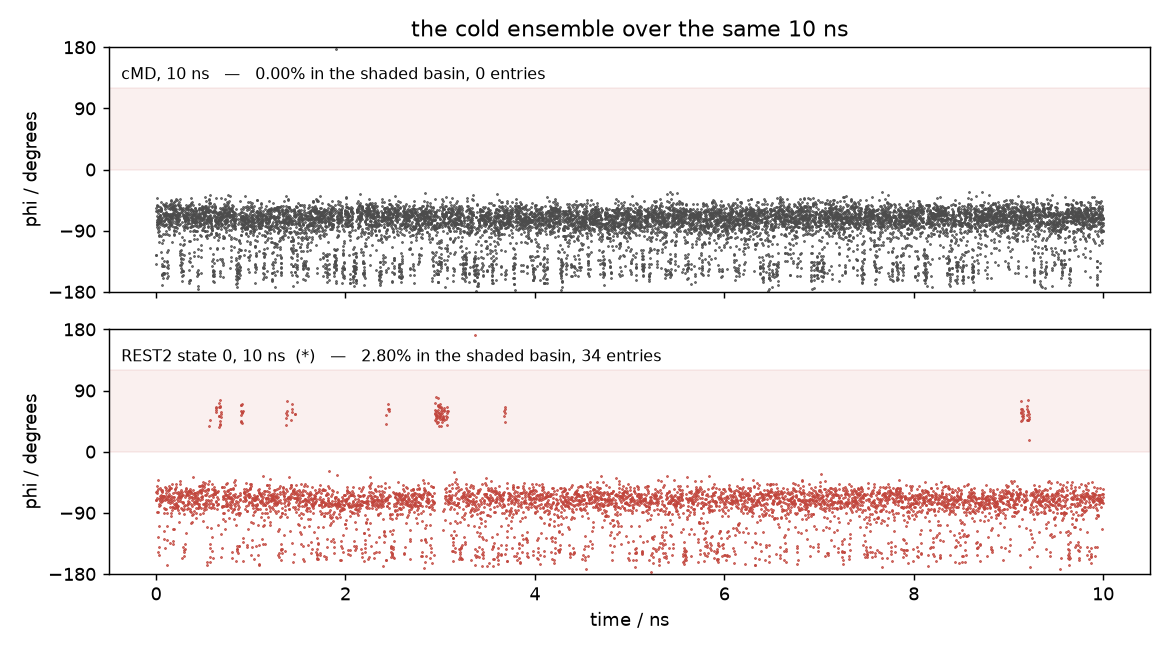
Over the same ten nanoseconds the plain run never leaves the negative-φ region, while state 0 enters αL seven separate times. Both integrate the identical Hamiltonian; the difference is entirely in where the configurations came from.
The crossing rate is where the mechanism shows: 3.40 entries per nanosecond against 0.02, a factor of 170. That is what the exchanges buy. Nothing about state 0's Hamiltonian differs from the plain run's; the walkers occupying it have simply been up the ladder, crossed the barrier while the torsion was weakened, and come back down.
The ladder's estimate is better determined than the reference's
This reads backwards until you count events rather than frames. The microsecond wrote 100 000 frames but entered αL 16 times; the ladder wrote 5000 frames and entered 34 times. An occupancy is determined by the number of independent visits, not by how often the trajectory was sampled, so the 10 ns ladder constrains that 2.8% roughly 1.5× more tightly than the run that took a hundred times longer.
The same fact is why a still-longer unbiased run is the expensive way out of this: crossings accumulate linearly in time, so matching the ladder's 34 events would take about 1.7 µs.
If the two had disagreed while both crossed freely, the suspicion would point the other way —
velocities rescaled on exchange, walker-indexed trajectories written as state-indexed, or a tau
claim that did not match the saved state. None of those appear in any completion record; every one
of them would still report status: completed.
Next
- the same peptide annealed rather than exchanged: AIS: alanine dipeptide
- the unbiased reference: cMD: alanine dipeptide
- a ladder where the τ span had to be measured rather than assumed: choosing τ_max